
Advanced physiotherapy in La Laguna
guided by ultrasound.
Ultrasound at every assessment, so we locate the injury precisely and guide the treatment in real time, with no guesswork.
Led by Eduardo Martín, podiatrist and physiotherapist in La Laguna, with over 20 years of experience, accredited by the Real Federación Española de Voleibol at the Rio 2016 and Paris 2024 Olympic Games.
Who will be treating you
Podiatry and physiotherapy in the same pair of hands, with postgraduate training and experience in high-level sport. The same person assesses you, explains what is going on and treats you.
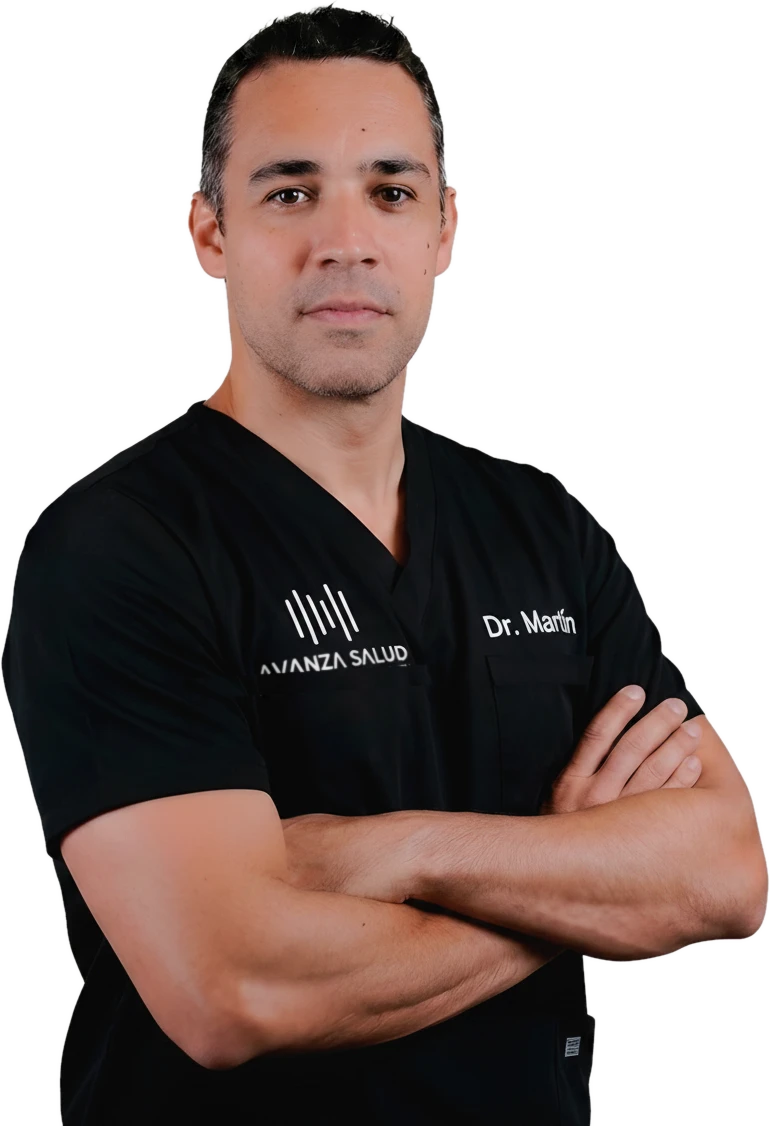
Eduardo Martín
Clinical director · Physiotherapist and podiatrist
"Two decades giving patients their movement back."
Founder of Avanza Salud, with over 20 years of clinical experience. Podiatrist and physiotherapist, master's degree in Manual Therapies and PhD candidate in Health Sciences. Physiotherapist accredited by the Real Federación Española de Voleibol at the Rio 2016 and Paris 2024 Olympic Games, and a university lecturer in physiotherapy.
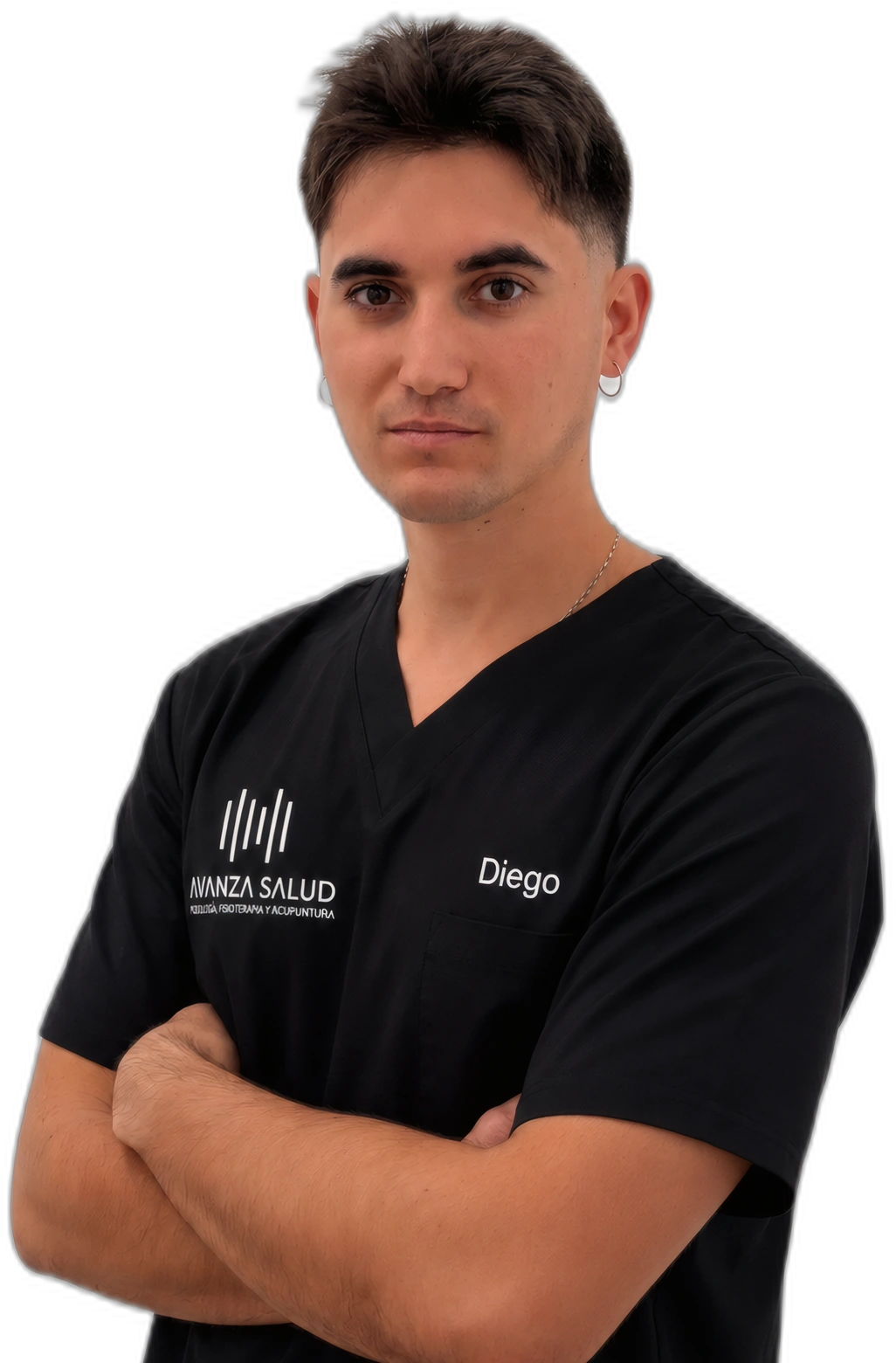
Diego Bacallado
Physiotherapist · Return-to-sport and ultrasound-guided care
"From pain back to competition, one step at a time."
Registered physiotherapist on the team, focused on the athlete: return-to-sport rehabilitation and return to competition, training and injury prevention, and ultrasound-guided needling techniques such as dry needling. He follows every recovery from the pain through to high performance, with ultrasound monitoring and clear goals at each phase.
Manual therapy: the foundation of every treatment
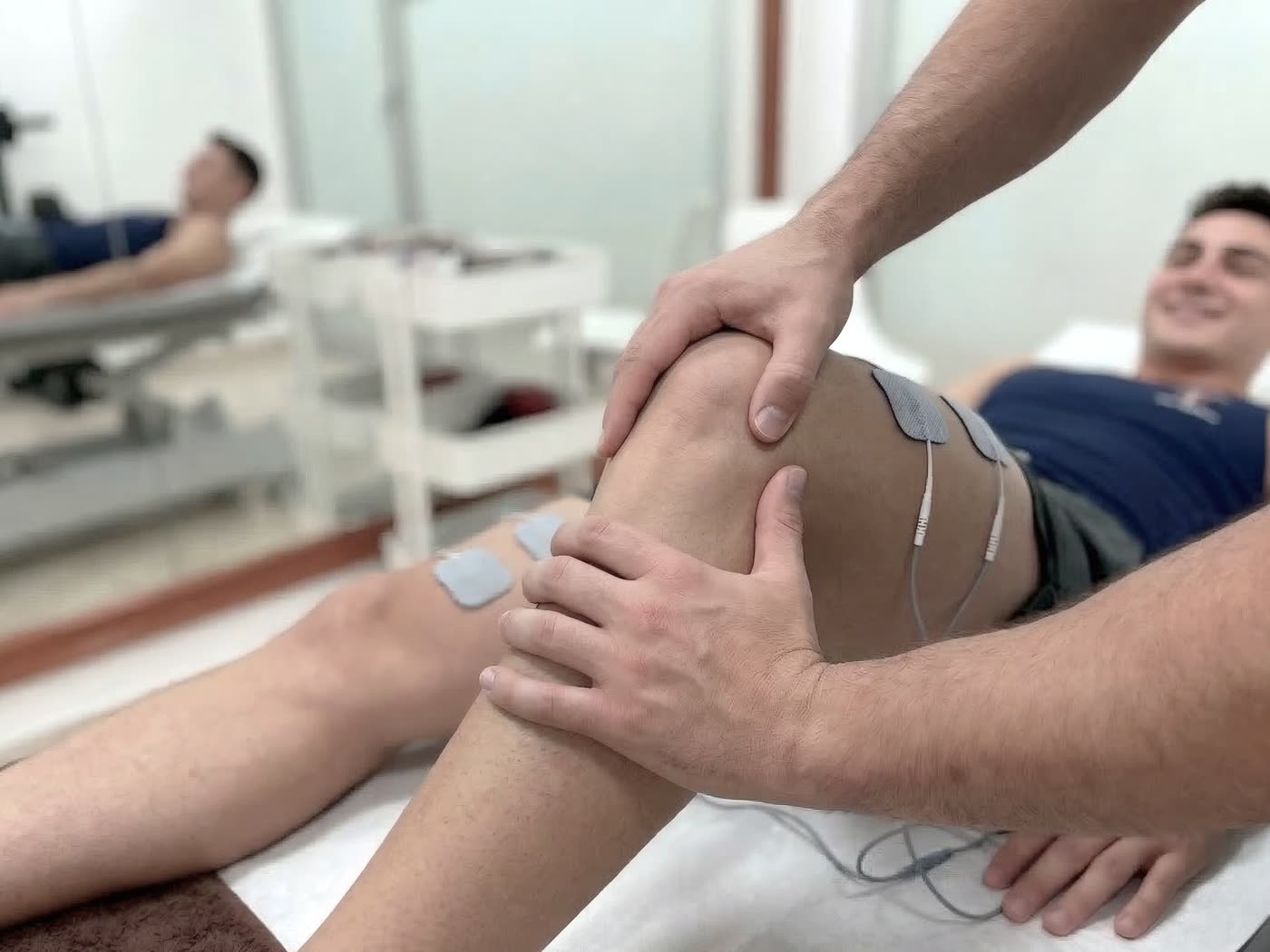
At Avanza Salud we believe firmly in what the hands can do. Manual therapy is far more than an add-on: it is the base on which any effective physiotherapy treatment is built. Through direct contact we assess, diagnose and treat musculoskeletal dysfunction with a precision that no machine can replace.
We use joint mobilisation, spinal manipulation, clinical soft tissue massage and neurodynamic techniques, always with clinical judgement and adapted to what each patient needs. Listening carefully and clinical reasoning are our most valuable tool.
Joint mobilisation
Restoring range of movement and normal joint mechanics.
Spinal and peripheral manipulation
High-velocity, low-amplitude techniques to restore movement that has become blocked.
Neurodynamic techniques
Mobilisation of the peripheral nervous system to treat referred pain and mechanical neuropathies.
Myofascial therapy
Releasing restrictions in the fascia to restore whole-body movement.
Instrument-assisted therapy: mechanical precision on soft tissue
Non-invasive techniques that use purpose-made instruments to reach deep structures (fascia, adhesions and periosteum) that the hand alone cannot reach with the same precision.
Diacutaneous fibrolysis
Uses metal hooks to release adhesions and fibrosis at the tissue interfaces (skin, fascia, muscle and periosteum). It reaches abnormal mechanical tension that cannot be worked from the surface. It shares its principles with the Graston technique, the American method of reference using similar instruments. Indicated in tight scars, post-surgical adhesions and persistent pain syndromes.
Kaltenborn wedges
Wedge-shaped instruments from the manual therapy concept of Freddy Kaltenborn and Olaf Evjenth. They allow graded, sustained pressure on joint and periarticular structures, which makes mobilisation with controlled leverage possible in stubborn joint dysfunction.
Kaltenborn belts
The belts are another element of the Kaltenborn-Evjenth whole-body concept. Traction bands applied to the segment being treated produce joint decompression and a specific direction of movement, which reinforces the therapist's manual mobilisation and improves joint range step by step.
Precision needling techniques
When conventional techniques are not enough, minimally invasive physiotherapy often makes the difference in persistent or stubborn conditions. Always under strict clinical judgement and with the highest safety standards.
Dry needling
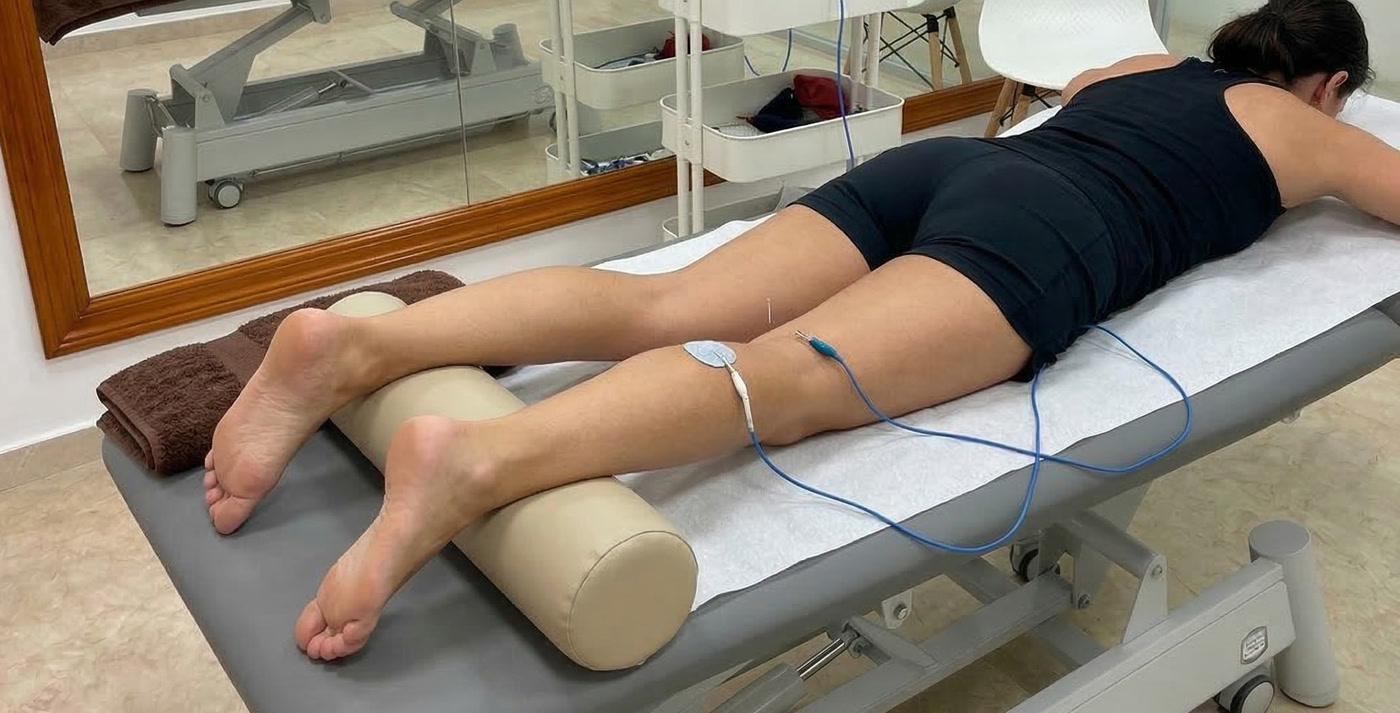
A minimally invasive physiotherapy technique that uses acupuncture needles to treat myofascial trigger points (MTrPs): hyperirritable spots in the muscle that produce local and referred pain. It produces a local twitch response that releases the tension built up there, easing the pain quickly and for longer.
Percutaneous neuromodulation
Combines the needle with low-frequency electrical current to modulate the activity of the peripheral nervous system, with pain-relieving and regenerative effects that reach further than conventional dry needling. Particularly useful in persistent pain, neuropathies and conditions that are hard to resolve.
Percutaneous needle electrolysis (EPI / EPTE)
Applies galvanic current through a needle onto the degenerated tissue, switching on tissue repair. The technique of choice in persistent tendinopathies that resist conventional treatment.
Recommended reading: plantar fasciitis, which treatments work according to the evidence (in Spanish)
The protocol shared by all three techniques
Dry needling, percutaneous neuromodulation and electrolysis are always carried out under real-time ultrasound guidance. Ultrasound locates the target tissue (trigger point, nerve or degenerated area) to within a millimetre, which keeps every session as effective and as safe as possible.
Latest-generation technology
We combine what the science says with the therapeutic technology available, to speed up your recovery and improve the results of treatment.
Diathermy (Indiβa / radiofrequency)
Diathermy activates cell metabolism using high-frequency electromagnetic energy that generates deep heat in the tissues. It reduces inflammation, increases local circulation and speeds up regeneration. The Indiβa system works in capacitive and resistive modes, so the treatment can be adapted to each type of tissue and condition. Indicated in both acute and persistent processes.
Musculoskeletal ultrasound
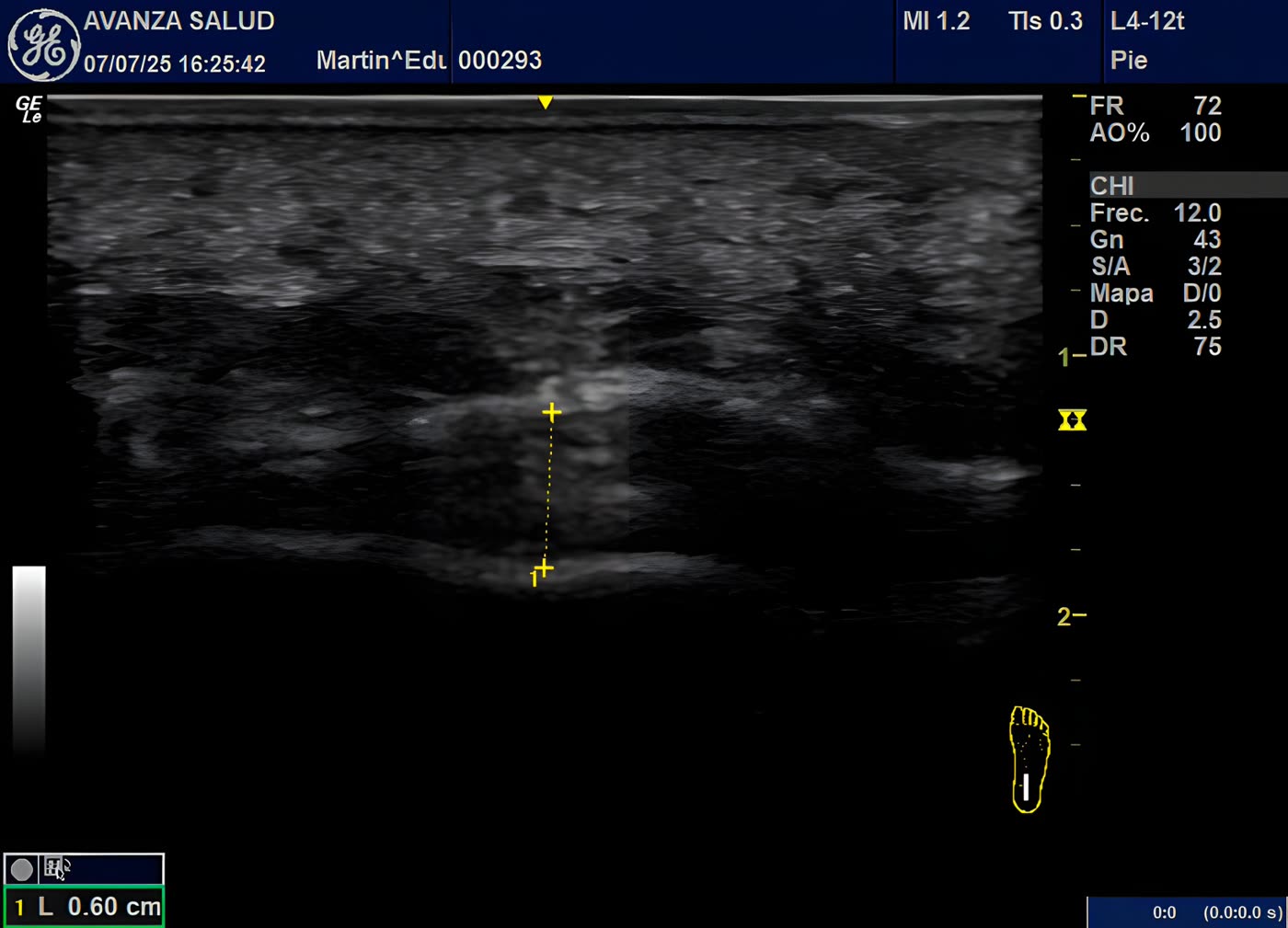
Ultrasound is a key tool both for assessment and for guiding minimally invasive techniques. In physiotherapy we use it to see the real state of the tissue (tendon, muscle, ligament, nerve), to monitor how treatment is progressing and to keep ultrasound-guided procedures precise. Seeing means treating better.
AI and its use in healthcare
Artificial intelligence is changing physiotherapy: from the analysis of movement patterns and the processing of ultrasound images to the design of tailored exercise plans and following a patient's progress remotely. At Avanza Salud we bring these digital tools in to support clinical judgement, never to replace it, so that care is more precise, more personalised and continues beyond the consulting room.
Sports physiotherapy in La Laguna
Sports physiotherapy treats the injury and also its cause: the movement pattern, the training load and the foot strike. With experience in elite sport and ultrasound at every assessment, we work with runners and athletes from across Tenerife without keeping them out of training any longer than necessary.
Runners' injuries
Iliotibial band syndrome, medial tibial stress syndrome, Achilles tendinopathy or plantar fasciitis: the overuse injuries seen most often in running, assessed with ultrasound and treated with a progressive loading plan.
Runner's knee, explained (in Spanish) →From treatment back to sport
Once the injury has settled, the second half of the work begins: rebuilding strength, technique and confidence. Sports physiotherapy runs straight into our return-to-sport rehabilitation programme, with no step in between.
Return-to-sport rehabilitation in La Laguna →The cause is in your gait
Many repeat injuries start with how you walk and run. A biomechanical gait and running assessment picks up imbalances and leg length discrepancy, and guides the treatment and the custom orthoses if you need them.
Gait analysis in La Laguna →Rehabilitation and functional recovery in Tenerife
We stay with you through the whole recovery, from the injury or the surgery until you are back to your activity. A progressive plan, measured with ultrasound at every review.
Sports rehabilitation
Recovery from sports injuries and return-to-sport rehabilitation so you can train again safely, with every phase checked by ultrasound.
Post-surgical rehabilitation
Recovery after an operation, working alongside your surgeon or orthopaedic consultant, to rebuild movement and strength at your own pace.
Functional recovery
Moving again without pain in your daily life after an injury, persistent muscle tightness or a period of immobilisation.
Which conditions do we treat in physiotherapy?
A guide to the injuries and conditions we most often treat in physiotherapy at Avanza Salud, La Laguna.
Spine
- Cervical and neck pain
- Acute and persistent low back pain
- Disc herniation
- Sciatica and referred pain
- Spinal canal stenosis
Sports injuries
- Sprains and dislocations
- Muscle tears
- Overuse tendinopathies
- Iliotibial band syndrome
- Knee injuries (ligaments, meniscus)
Upper limb
- Lateral epicondylalgia (tennis elbow)
- Rotator cuff syndrome
- Shoulder pain and frozen shoulder
- Carpal tunnel syndrome
- De Quervain's tendinopathy
Lower limb and foot
- Plantar fasciitis
- Achilles tendinopathy
- Chondromalacia patellae
- Patellofemoral pain syndrome
- Medial tibial stress syndrome (shin splints)
Persistent conditions
- Fibromyalgia
- Myofascial pain syndrome
- Osteoarthritis and arthritis
- Persistent pain that is hard to manage
- Peripheral neuralgia
Post-surgical
- Recovery after knee surgery
- Shoulder post-operative care
- Scars and adhesions
- Hip and knee replacements
- Post-arthroscopy
What our patients say
Real patient reviews on Google, with an average rating of 4.9 out of 5.
Clear pricing, no surprises
Ultrasound lets us see the tissue we are treating and match each technique to your particular injury, with the double perspective of a clinician who is both a podiatrist and a physiotherapist.
First assessment with ultrasound
€60
Full examination, musculoskeletal ultrasound and a personalised treatment plan.
Treatment session
€50
A physiotherapy session driven by your plan, with ultrasound guidance whenever the technique calls for it.
Same-day reply by WhatsApp or phone.
Shall we start by finding out what is going on?
The first assessment includes ultrasound and a treatment plan built around you. Book by phone or WhatsApp and we will see you the same day.